Wednesday, September 17, 2008
Summertime
http://www.youtube.com/watch?v=lcN5Vaqd9sg
Summertime
Do some people wind up with the one that they adore
in a heart-shaped hotel room it's what a heart is for
the bubble floats so madly will it stay sky-high?
Hello partner, kiss your name bye-bye
ooh sometimes...
romantic piscean seeks angel in disguise
chinese-speaking girlfriend big brown eyes
liverpudlian lady, sophisticated male
hello partner, tell me love can't fail
& it's you and me in the summertime
we'll be hand in hand down in the park
with a squeeze & a sigh & that twinkle in your eye
& all the sunshine banishes the dark
do some people wind up with the one that they abhor
in a distant hell-hole room, the third world war
but all I see is films where colourless despair
meant angry young men with immaculate hair
ooh sometimes...
Get up a voice inside says there's no time for looking down
only a pound a word & you're talking to the town
but how do you coin the phrase though
that will set your soul apart
just to touch a lonely heart
& it's you & me in the summertime
we'll be hand in hand down in the park
with a squeeze & a sigh & that twinkle in your eye
& all the sunshine banishes the dark
& it's you I need in the summertime
as I turn my white skin red
two peas from the same pod yes we are
or have I read too much fiction?
Is this how it happens?
How does it happen?
Is this how it happens?
Now, right now
The Silver Lining
Thursday, September 11, 2008
Wednesday, September 10, 2008
No Apologies
(Russian RT-2PM Topol ICBM, on display at the 2008 Victory Parade in Moscow)"designed to protect against what it says are threats from rogue countries, such as Iran"They make these claims in order not to "provoke" Russia. If the missile defense system isn't designed to protect against Russian missiles, it ought to be.
Russia is as unstable and rogue a nation as Iran or North Korea. There is no rule of law under Putin, no property rights, no free speech. There is only the law of Putin, ex of the KGB. As Russia's recent invasion of Georgia and virtual annexation of two of Georgia's provinces demonstrates, the country is hungry to reassemble its broken empire, even if it has to do it one little piece at a time.
Russia has potential conflicts brewing all over the place, from the Baltic Republics ( http://tinyurl.com/59vv3z ) to the naval port of Sevastopol in the Crimean peninsula ( http://tinyurl.com/5ndwuq ). Putin is a loose canon who knows only one law: the lust for power.
If we aren't taking active measures to protect ourselves from this lunatic, there's something wrong with us. Putin's Russia is helping the Iranian theocracy develop nuclear technology, and strengthening Iran's air defense system
( http://tinyurl.com/5pj22c ).
Putin's Russia has resumed long range bomber patrols over the Atlantic, their bombers are buzzing our aircraft carriers, and their joint naval and air exercises are targeting NATO countries
( http://tinyurl.com/2ogv73 and http://tinyurl.com/5el6vk ).
Now Putin's Russia is scheduling joint naval exercises with Venezuela, the country headed by the militantly anti-American Hugo Chavez ( http://tinyurl.com/6x3h5v ).
Why aren't we deploying a missile shield against Putin's Russia? We should do so asap, with apologies to no one.
Monday, September 8, 2008
Ulysses

Analysis of this great poem would be superfluous. It is not complicated, merely beautiful, heroic, and inspirational. They don't write them like this anymore.
Friday, September 5, 2008
Another Nail in the Coffin of Free Speech
MEPs want TV regulators in the EU to set guidelines which would see the end of anything deemed to portray women as sex objects or reinforce gender stereotypes.
And furthermore:
Swedish MEP Eva-Britt Svensson . . . said: "Gender stereotyping in advertising straitjackets women, men, girls and boys by restricting individuals to predetermined and artificial roles that are often degrading, humiliating and dumbed down for both sexes."
These assertions are obviously false. Advertising is incapable of restricting anyone from doing anything. Only the government has the power to restrict people's actions. Advertisers can only try to persuade.
How does an advertisement of a woman wearing lingerie, for example, restrict any woman from becoming an engineer? It doesn't. Eva-Britt Svensson and her fellow EU busybodies simply don't like what some women do, and therefore wants to restrict them by law from doing such things. It is the government, as always, that is "restricting" women and men alike by curtailing their right to decide for themselves what to do with their own lives.
It's been said before, and it bears repeating: the road to totalitarianism is paved with good intentions.
Wednesday, September 3, 2008
Black and White Movies
_05.jpg)
This is a still frame, or a publicity photo, from the movie Laura, starring Gene Tierney and Vincent Price, among others. I love this photograph because it exemplifies the elegance and stylishness of black and white movies of the 1940s.
Also the photograph tells a story in itself, with these two beautiful people sizing each other up, the man looking suave and a little too relaxed, the woman, Laura, sure of herself but still unsure of the man she's with, trying to penetrate the facade he seems to present to the world.
At least the photograph suggests all of this to someone who has seen the movie.
Saturday, August 30, 2008
A Word and Its Meaning
I recently purchased the booklet called Glossary of Objectivist Definitions, which includes definitions by Ayn Rand, Leonard Peikoff, and Harry Binswanger. Having a solid grasp of the meaning of the words one uses is obviously important. I thought it would be a good exercise to occasionally take one of the definitions, and then give an example of it in action, either in the real world or the world of art.
Here is the Glossary's definiton of integrity:
"Integrity" is loyalty in action to one's convictions and
values. (Glossary of Objectivist Definitions, p. 25.)
As given, this definition is open to misinterpretation. It leaves open the question of whether one's convictions and values are rational. Being loyal in action to irrational values is not an example of integrity. And as I suspected, when I turned to the original passage from which this definition was taken, the chapter on Virtues in Leonard Peikoff's Objectivism: the Philosophy of Ayn Rand, he does indeed qualify integrity to mean loyalty to rational values:
Like independence, integrity is a derivative of rationality and precludes any form of emotionalism. It does not mean loyalty to arbitrary notions, however strongly one feels they are true. Adolf Hitler acting faithfully to carry out his hatred of the Jews is not an example of virtue. Integrity means loyalty not to a whim or delusion, but to one's knowledge, to the conclusions one can prove logically. Like every other virtue, therefore, integrity presupposes a mind that seeks knowledge, a mind that accepts and follows reason. (Leonard Peikoff, OPAR, p. 261, paperback edition.)There are countless good examples of integrity in the Korean drama, Dae Jang Geum. Integrity is one of Jang Geum's distinguishing characteristics, which separates her from most other people of that time, or any other.
A good example that comes immediately to mind is an episode in which a high ranking Chinese envoy comes to visit the Korean King, and Lady Han and Jang Geum are chosen to cook for him. At first, they begin preparing the tastiest dishes a healthy man could wish for. The Head Eunuch had told them that: "We can't allow even a hint of fault in formalities or food. The senior envoy is a well known epicure in China. If it's not the best of delicacies, he won't even touch it. So show your best talent."
But then they learn that the Chinese envoy has diabetes, and is in poor health after his long journey. So Lady Han instead prepares the healthy foods, mostly vegetables, that are best for a diabetic, without telling the Head Eunuch.
When this food is served to the envoy, the Korean dignitaries are horrified, and so is the Chinese envoy. Lady Han tries to explain. Both she and Jang Geum believe that a cook's purpose is to prepare food that is both palatable, and proper for the person who will be consuming it. A diabetic must be served healthy food, even if he is too shortsighted to choose to eat it himself. "I dare to say the greasy food of Ming is very detrimental to his health."
The result of this conflict is that Lady Han is arrested and put in confinement until a decision is made on her ultimate punishment. In the meantime, Jang Geum steps in for Lady Han. Here she could, as most people would do, simply substitute some tastier, less healthy food for the Chinese envoy, which is exactly what he and the Korean dignitaries specifically order her to do. But she refuses. "We cannot possibly bring food that is harmful for the person."
In the face of threats of her own arrest, and very possibly being executed, Jang Geum insists on serving the same healthy food that Lady Han had planned to serve. The Chinese envoy is struck by her courage, but still does not want the healthy food. Jang Geum reasons with him, explaining that within as few as five days he will begin to feel better if he only eats the healthy food she plans to serve. Finally, the envoy agrees to eat it. But he does so with this proviso: "Will you receive any punishment I order - even if it means your life [if I am not satisfied with the food]?"
Jang Geum accepts the terms. She has confidence in her knowledge of food and its effect on a person's health, and more importantly, she refuses to go against her conviction that a cook must serve food proper to the person consuming it, in this case a diabetic.
Meanwhile, the Head Eunuch, who is generally a good person, but not as courageous as he might be, goes to Lady Han and asks her "How could you prepare such a meal?" He knows the envoy has diabetes, but is only concerned with giving him what he wants. Lady Han responds perfectly, by saying: "Then are you telling me to do the same thing to the King as well?" In other words, is he telling her that she should serve the King unhealthy food also, even if it kills him? The Head Eunuch is unable to respond to this point, because he knows Lady Han is right.
In stark contrast to the integrity of Jang Geum and Lady Han, their arch enemies, Lady Choi and Keum Young, begin preparing a feast of royal proportions for the Chinese envoy, confident that he will not be satisfied with the plain, healthy food Jang Geum will be serving. The meals Lady Choi prepares are the very greasy Ming dishes that are worst for a person with diabetes, but they are exactly the kind of foods that the Chinese envoy enjoys eating.
After the five days of eating Jang Geum's healthy food are up, Lady Choi immediately serves the envoy her lavish meal of tasty - but unhealthy - dishes. The envoy samples several of the dishes and is obviously delighted with their taste. Lady Choi smiles, anticipating a decisive victory over Lady Han and Jang Geum. But then the envoy stops eating her food, and says that although it is very tasty, he now realizes the healthy food is the better choice. He does indeed feel better after five days of Jang Geum's healthy food, which she managed to make tasty enough to satisfy the finicky envoy.
So Lady Han is realeased from confinement, Jang Geum is praised for doing the right thing (by all the same people who would have condemned her, if she had not satisfied the envoy), and Lady Choi is mortified by her loss of face. The actions of Lady Han and Jang Geum are a perfect example of loyalty in action to one's convictions and values, a perfect example of integrity.
And that example could be multiplied by anyone who watches Dae Jang Geum, for Jang Geum, along with Lady Han, Lady Jung, and Min Jeong Ho, are all heroic characters distinguished for their integrity throughout their entire lives.
[Edited 09-01-2008]
Watching, Listening
Thursday, August 28, 2008
Sull'aria
My favorite duet from my favorite opera. Sull'aria, from The Marriage of Figaro, by Mozart. The ladies are Kiri Te Kanawa and Ileana Cotrubas.
Sull'aria . . .
On the breeze . . .
Che soave zeffiretto . . .
What a gentle zephyr . . .
Zeffiretto . . .
Zephyr . . .
Questa sera spirera!
Will sigh this evening!
Questa sera spirera . . .
Will sigh this evening . . .
Sotto i pini del boschetto.
Beneath the pine grove.
Sotto i pini?
Beneath the pines?
Sotto i pini del boschetto . . .
Beneath the pine grove . . .
Ei gia il resto capira.
He will understand the rest.
Certo, certo il capira.
Certainly, he'll understand.
Ei gia il resto capira.
He will understand the rest.
Canzonetta sull'aria . . . etc.
Little tune on the breeze . . . etc.
The Democratic National Convention
I cannot see these people for an instant without being reminded of Shakespeare's line: "A man can smile and smile - and be a villain." The only thing that separates American Democrats from Hugo Chavez is that they don't have the power, yet, to do what Chavez is doing to Venezuela. They are simply constrained to go about it with more devious methods, by regulating the free enterprise system to death. They are more than half way there, already.
I literally would not vote for a Democrat if you held a gun to my head. To do so would be a betrayal of everything the Foundning Fathers fought for - and everything I believe in. I would rather be dead than assist in the victory of the worms of the Democratic party over the giants who founded our nation.
None of which is meant to imply any endorsement of Republicans. They are awful, too, especially with regard to the mixing of religion and government. Which means I probably will have to abstain from voting altogether. When you are offered a choice between the party of Torquemada and the party of Stalin, you sign your own death warrant, and that of your nation, by voting for either one.
Sunday, August 3, 2008
Escapism aka Fantasy
Some remnants of Romanticism may still be found in the popular media---but in such a mangled, disfigured form that they achieve the opposite of Romanticism's original purpose . . .
Under the pressure of conformity . . . today's Romanticists are escaping, not into the past but into the supernatural---explicitly giving up reality and this earth. The exciting, the dramatic, the unusual---their policy is declaring, in effect---do not exist; please don't take us seriously, what we're offering is only a spooky daydream. (Ayn Rand, What Is Romanticism?)
I use the above quote not to suggest that Ayn Rand would agree with my assessment of modern fantasy, but to show that she saw the perils inherent in the genre, to which some had already succumbed. My view is that virtually all modern fantasy has descended into escapism.
And I am sick to death of it. In literature, in tv shows, and in movies, fantasy is flooding the marketplace. In modern history fantasy was little more than a blip on the radar screen, until Tolkien's The Lord of the Rings was published. After that, the deluge.
First it wormed its way into the science fiction section of book stores and grew like a weed until there was little if any science fiction left that was worthy of the name. Just a lot of fantasy masquerading as science fiction.
I'm not sure what started the craze for fantasy shows on television. There were a few mild ones in the 60s, such as Bewitched and I Dream of Jeannie. Now they are everywhere. And instead of it being something to laugh at, as it was with the two aforementioned shows, we are expected to take it seriously in shows like Charmed, Buffy the Vampire Slayer, Angel, The X-Files, Lost, etc.
What makes a blockbuster movie these days? Fantasy and comic book heroes. The Lord of the Rings. The Chronicles of Narnia. The Golden Compass. Spiderman. Batman. Harry Potter. The Mummy. Hellboy. Ironman. Etc., ad nauseum.
Now the big seller among fiction books, after the fantasy Harry Potter phenomena has died down a bit, is what? A series about vampires, The Twilight Saga, by Stephenie Meyer. It's selling like hotcakes.
Why do authors want to set their stories in unreal worlds? Anti-rational worlds? Why do they want their characters to have magical powers? What is it about real life that so bores them, that they have to imagine a different world where A is not A. In order to be heroic, why must a man have unreal superpowers? Why do readers want to read this stuff, instead of stories about heroes in the real world, who have only their human mind and human body to use in dealing with the problems that beset them? Why do people want to escape the real world, and run away into fantasy?
The impression all this escape into fantasy worlds leaves is that heroism isn't possible in the real world. Heroes are only possible in some other, fantasy world. In this sad vale of tears we actually inhabit, we must simply accept that there are no heroes.
Is the real world perfect? Far from it. But heroes don't run away and hide in little fantasy worlds. They fight to make their world better with what they have: their rational mind, their physical courage, their integrity. Wherein is there any need for fantasy here? There is nothing magical about it. It's not superhuman, it is simply man, the paragon of animals, man the hero, living up to his potential.
If you want to see what real literature can and should be like, watch Dae Jang Geum. Thank goodness someone is still creating great, realist art.
[Edited 8-13-08]
Friday, July 25, 2008
The Music Man
There were bells on the hill
But I never heard them ringing,
No, I never heard them at all
Till there was you.
There were birds in the sky
But I never saw them winging,
No, I never saw them at all
Till there was you.
And there was music,
And there were wonderful roses,
They tell me,
In sweet fragrant meadows of dawn, and dew.
There was love all around
But I never heard it singing
No, I never heard it at all
Till there was you!
This is one of the best songs from one of the best musicals ever, The Music Man, lyrics and music by Meredith Willson. The scene in which this song appears, below, is the key to the whole story. Taken literally, Robert Preston's music man character is a charlatan. He says he can teach children to play music, and the citizens of the town pay him to do so. But he cannot actually teach music at all. The people do not get what they paid for.
But they get something else, at least as valuable. For the Music Man brings the town and its people to life. He makes them happy and excited, he makes them sing and dance, he even brings love, if only fleetingly, to one who had never known it before. He instills in them the courage to do what they never dared to do before. He makes their lives worth living. And that is an enormous gift to bring to anyone, let alone a whole town.
Only one person, the mayor, is so dour as to take the Music Man literally, and see him as simply the charlatan that he appears to be on the surface. He suggests the people tar and feather the Music Man. But everyone else in town - even the mayor's wife - supports the Music Man against the mayor. In spite of having been conned about his music teaching ability.
In addition to Till There Was You, there are several other wonderful songs in The Music Man. Lida Rose, Marian the Librarian, Seventy-Six Trombones, just to name a few. Robert Preston and the lovely Shirley Jones give magnificent performances, and the Buffalo Bills quartet will make you understand the beauty of the barbarshop quartet.
Watch the YouTube clip below for a taste, then buy or rent the DVD and enjoy the whole wonderful story. We need more Music Men in the world.
Thursday, July 17, 2008
Renee Olstead - Merry Christmas In Love
Merry Christmas in Love
Lyrics by Marva Jan Marrow, music by Tony Renis, performed by Rene Olstead
Things that tremble tingle like a bubble full of rainbows . . . then crack
Sizzle, sing and whisper, when the shadows lace the moonlight with black
Things with silver linings, sparkling tinsel, twinkle shining with . . .
Waving wispy willow wings that breathe a song of Christmastime dreams . . .
Things that glow and glisten, eyes of children when they listen . . . then burst
Things that touch the wistful wish of watching someone else succeed first
Days that dingle dangle with a million parts untangle to
Satin stars that spangle and those Christmas bells that clangle out . . . dreams . .
I'm dreaming of Christmas
To you, Merry Christmas
Dreaming . . . of a Merry Christmas
To you, Merry Christmas
Galloping and gliding, Santa Claus' sleigh we're riding and
Bringing joyful tidings to the dreamers who are lying below . . .
I'm talking of daydreams
Wishes and moonbeams
Then I tremble tingle like a bubble full of rainbows and light
When you came to wake me and to wish me Merry Christmas in love . . .
Christmas in love . . .
I can tremble tingle like a bubble full of rainbows and light
When you came to wake me and to wish me Merry Christmas in love . . .
Merry Christmas in love . . .
Saturday, July 5, 2008
Friday, July 4, 2008
It's a Good Life
So everyone had to think happy thoughts, especially about Anthony himself, or it was off to the cornfield with them. Anthony didn't like singing, so no one could sing, or play any records with singing. Once Anthony decided to make it snow, thereby ruining much of that season's crops, it being the growing season. Anthony's father was initially horrified, but quickly recovered his senses, and admitted that it was good that Anthony made it snow. "That's a good thing you did, Anthony."
Anthony had turned the little town of Peaksville, Ohio into his own little kingdom, of which he was the absolute monarch and God. No one could leave the town, no one else could come in. The rest of the world had, for all practical purposes, ceased to exist. The population was shrinking, since he occasionally got angry with some of the residents and sent them to the cornfield, whence no one returned. The crops suffered from his whims, as did the livestock and other domestic animals, like dogs.
I've seen this episode before. But this time it struck me as an excellent description of life under an absolute ruler, whether a modern dictator, or a traditional monarch. Historically, such rulers had, and the modern ones continue to have, absolute power, including the power of life and death over all of his or her subjects, which could be, and often was, exercised at whim. So the subjects must all live in fear of the ruler, and pretend to be happy and agree with any whim of the ruler, lest they be sent to the cornfield.
So, for example, if a King wanted to levy a huge new tax on "his" people, in order to build a colossal new luxury palace, what could the hapless subject say? "That's a good thing you did, your Majesty."
And if a dictator wants his farmers to stop farming and melt their "extra" pots and pans, and anything else they can find that is made of iron, to increase the country's steel production statistics? And this will cause thousands to die of starvation, since the crops are being neglected? Students, too, and their teachers, must spend all their time searching for scrap metal to melt down, and forget about classes? "That's a good thing you did, Chairman Mao. I'm very happy!"
That last example was something that actually happened in China under Mao, circa 1957. In describing it, Chinese author Jung Chang wrote:
This absurd situation reflected not only Mao's ignorance of how an economy worked, but also an almost metaphysical disregard for reality, which might have been interesting in a poet, but in a political leader with absolute power was quite another matter. One of its main components was a deep-seated contempt for human life. (from Wild Swans, by Jung Chang)
That's a perfect description of Anthony, absolute ruler of Peaksville, Ohio. And also of Kim Jong-il. And it represents everything Hugo Chavez aspires to be, as well.
The episode also shows one character who refuses to submit to this pathetic slave existence. He starts singing in Anthony's face, and telling him exactly what a monster he is. Anthony begins threatening him with the cornfield. The rebel then pleads with the other victims to take advantage of Anthony while he is distracted by this rebellion, and attack him. But no one else does, and the rebel is sent to the cornfield. This also is similar to life under a dictatorship. The bravest ones are the first to die, or end up in prison, because they agree with Patrick Henry. But most people simply submit like sheep, and go on living as slaves.
Wednesday, June 25, 2008
Democracy: The Modern Idol
In a post ( http://www.icahnreport.com/report/2008/06/corporate-democ.html ) to his blog on June 18, Carl Icahn wrote about "the myth" of corporate democracy. He complains that "many corporate boards and managers are doing an abysmal job." He believes this is a result of poor corporate governance, and claims that "the average shareholder can do nothing about it." Further, "It is the board’s responsibility to hold a CEO accountable, and remove the CEO if he or she is not producing results," but this often does not happen, writes Icahn, because "boards are often too lazy and/or passive to rock the boat, especially since the company will continue to pay and pamper and even indemnify them under almost any circumstances."
"Worst of all," he writes, "the board itself is not made accountable because corporate board elections are generally a joke." This is because " . . . in corporate America there are no true elections. It is tyranny parading as democracy . . . Perhaps, with enough public support, the lawmakers and regulators will take note." (Emphasis added.)
Icahn also quoted Winston Churchill, implying that political governance and corporate governance are one and the same: "To paraphrase Winston Churchill, 'democracy might not be the greatest system there is but it is the greatest system mankind has invented so far.' "
And the Response:
In politics, democratic elections allow the citizens to choose representatives to run the day to day business of the government. What those representatives may do, however, is strictly limited by the US Constitution. We live in a Republic, not a Democracy. In a Democracy, a majority could vote to do anything under the sun. It is mob rule. In a Republic, the rights of the individual are protected from violation by majorities. Thank the Founding Fathers we live in a Republic, and not a Democracy.
A corporation, however, is not the same as a political government. It does not exist to protect individual rights. It exists to make a profit. It draws up a business plan to do so, and anyone who wants in can buy shares of the company's stock, assuming there are shares for sale, at a price they can afford. In buying the company's stock, the investor agrees to abide by the company's rules. Including any rules about electing boards of directors. There is no guarantee he will make money on his investment.
No doubt there are CEOs and boards of directors that do abysmal jobs. But Icahn's claim that the average shareholder can do nothing about it is not true. At the very least, if a shareholder does not like what the board or CEO are doing, he can sell his shares in the company. If he prefers not to sell, he can vote (either in person, or by proxy) for directors he thinks will do a better job. The fewer shares he has, the less voice he has in such elections. Which is what he agreed to when he bought the shares in the first place. That is contractual justice.
Evidently Icahn is not satisfied with contractual justice, but instead wants government interference in the economy, like any statist. Odd, for a man whose blog is headed by a statement about fighting tyranny.
It is not clear exactly what Icahn wants the government to do in this particular intervention. His statement that "in corporate America there are no true elections. It is tyranny parading as democracy," suggests that he doesn't like how boards are elected. If that is so, he should either not have bought stock in those companies in the first place, or he should sell his shares, or he should work, in accordance with the company's rules, to get the rules changed. The one thing he should not do is appeal to the government to interfere in a business enterprise. That is not within a government's rightful sphere of influence. It is a common tactic, though, of people who can't get what they want legitimately, to try to get it illegitimately - through the government.
At the end of his post on corporate democracy, Icahn wrote "I will discuss in future entries how simple it [removing terrible management] can be and what has constrained us from taking action." Perhaps in these future entries he will suggest legitimate ways, and leave the government out of the equation. Let us hope so, at any rate.
Saturday, June 14, 2008
Secretariat: A Hero of a Horse

America had its first Triple Crown winner in a quarter of a century. Before the Belmont Stakes, Secretariat appeared on the cover of Time magazine, Newsweek, and Sports Illustrated, all in the same week. Everyone loved Secretariat. Once again, the media were filled with stories of a glorious achievement, pushing the doom and gloom stories off the front page, if only for a while.
Secretariat was the product of careful breeding, and was trained, groomed, managed, and ridden to be the best that he could be. He was a magnificent animal, and his greatness was guided and enhanced by human intelligence. We admired him for his achievements, his desire to excel, to be the "first among equals," to be the best.
No one ever suggested he should slow down so as not to embarass his brothers. We were free to admire his superiority over his peers. For those of us who love a hero, Secretariat was living proof that they could exist, and glory in their own existence.

http://tinyurl.com/4djwhv
Friday, June 13, 2008
Suicide by Environmentalism
But logic was never a strong suit among environmentalists. Consider the recent vote to continue restrictions on off shore drilling. The Democrats trotted out one of their standard excuses for not allowing more drilling:
"We are kidding ourselves if we think we can drill our way out of these problems," said [House Appropriations Committee Chairman David Obey, D-Wis], noting that no matter how U.S. oil sources are pursued “we still have a tiny portion of the world (oil) supply.” http://www.mgwashington.com/index.php/news/article/house-panel-defeats-coastal-drilling-expansion/1233/
Suppose for a moment that everyone, everywhere, took that attitude. Then no one would ever drill for oil except Saudi Arabia, and everyone would be 100% dependent upon them for their oil. That is the "logic" underlying the Democrat/environmentalist restrictions on drilling for oil. By that twisted logic, Americans should never have extracted any oil in this country at all, since we were never going to have more than a small percentage of the world supply.
But even that is giving the Democrats too much credit. There are enormous amounts of oil available from oil shale in this country, over and above all the oil waiting to be tapped off shore.
But environmentalists would rather fantasize about alternative energy sources like wind and solar - when they are not obstructing even those sources of energy, as eyesores. Last I heard, no one is stopping them from developing those energy sources themselves.
The free market could provide us with all the energy we need. If we had a free market.
Saturday, June 7, 2008
Red Wings in Action
Friday, June 6, 2008
Detroit Red Wings
Although Fedorov is no longer a Red Wing, he is indicative of the success of the franchise. The draft that netted Feodorov for the Red Wings is one of the greatest drafts in NHL history. That same draft for the Red Wings included Center Mike Sillinger and Defenseman Bob Boughner, who both went on to solid NHL careers. It included Winger Dallas Drake, who started with the Red Wings, was traded, and finally returned to the Wings as a free agent this season. It included Vladimir Konstantinov, a magnificent Defenseman who helped the Wings win the Stanley Cup in 1997, alongside his defense partner, Nicklas Lidstrom, who was also part of that same 1989 draft. Lidstrom and Fedorov will be in the Hall of Fame. Konstantinov almost certainly would have been too, had his career not been cut short by a tragic car accident, right after the Wings won the Stanley Cup in 1997. Picking three Hall of Famers in one draft is a good way to rejuvenate a franchise.
Eventually the Wings added three more skilled Russians to their lineup: Slava Kozlov, a skilled young Winger; Slava Fetisov, an aging but skilled defenseman, and Center Igor Larionov, a puck control specialist, as so many Russians were. Coach Scotty Bowman put these five together as a unit, the Russian Five, and they were amazing to watch. They played the same puck control game of the old Soviet national teams.
Eventually, all five of the Russian Five were lost to the Wings, to free agency, retirement, or career ending injury. But the Wings continued to play a puck control, or puck possession game, unlike any other team in the NHL. Because the Wings were so consistently good, they always ended up in poor drafting position. They haven't had a top ten pick since about 1991. Normally they pick at the very bottom of the round, about 20th or lower. So they never have the opportunity to draft the "can't miss" prospects like the Crosby's, the Malkin's, the Ovechkin's, etc.
That doesn't mean they don't draft great players, however. They do. They just have to look harder and smarter to find them. But find them they do. Pavel Datsyuk, Henrik Zetterberg, Tomas Holmstrom, Johan Franzen, Valtteri Filppula, all selected in the third round or later, all star players in the NHL. Datsyuk and Zetterberg, in my opinion, are the two most complete forwards in the NHL. And Nicklas Lidstrom is the best defenseman.
There are now seven Swedes on the Red Wings roster, with more on the way. The Wings are a heavily European weighted team. This is one of the results of having to pick lower in the draft, when all the best North American prospects are already gone. But it is also a result of a deliberate policy of favoring skill over size, which is the opposite of how most teams draft.
The results speak for themselves. Four Stanley Cups in eleven years. People used to accuse the Wings of buying the Stanley Cup, since they had one of the highest payrolls in the league. But when the salary cap was put in place, and the Wings' payroll was cut in half, they continued to be the class of the NHL, consistently finishing first in their division, and advancing well into the playoffs. And now, winning the Stanley Cup again.
The Red Wings are the model franchise of the NHL.
Tuesday, June 3, 2008
The Volga Boatman
As in We the Living, the revolutionary, named Feodor, is idealistic, although not nearly as intellectual as Andrei Taganov. The Russian noble, named Dmitri, is brave and arrogant, like Leo. The Princess, named Vera, does not resemble Kira particularly, but does have similarities with another Ayn Rand creation - Dominique Francon.
One scene that emphasizes this connection occurs near the beginning of the movie. Princess Vera hears some Volga boatmen singing as they pass near her home. The Volga boatmen are peasant laborers who pull boats against the current, up the Volga river, by means of ropes harnessed to their bodies. One of the singers in particular catches her ear, and she goes down with Dmitri to investigate who it is that sounds like "the soul of Russia."
So the wealthy young woman goes to look at the laborers, and sees the man she had heard singing, as he and the other boatmen are taking a rest break and a drink of water. She stares at the man, Feodor, in open admiration - and he stares right back, as openly as she. This recalled to my mind the scene in The Fountainhead in which Dominique went to her father's quarry and stared at Roark, who stopped working and stared back.
Then Dmitri intervened, and ended up giving Feodor two lashes across the face with his whip, leaving nasty cuts each time. Feodor took the blows without flinching. This too recalls the same sequence in The Fountainhead, although there it was Dominique who wielded the whip, and not a rival lover.
I don't know, of course, but it seems likely to me that AR wrote that scene as something of an homage to the similar scene in The Volga Boatman.
The movie itself claims to take no side in the conflict of the Russian Revolution, although it pretty clearly does favor the revolutionary side. Still, the heroes all run afoul of the revolution at one point or another.
I recommend the movie, which is available now on DVD.
Friday, May 30, 2008
Silent Movies
Among the silent movies that were enjoyed by the arch-romanticist, Ayn Rand, were The Indian Tomb (Part 1: The Mission of the Yogi; Part 2: The Tiger of Bengal), The Nibelungen (Part 1: Siegfried; Part 2: Kriemhild's Revenge), The Thief of Baghdad, The Mark of Zorro (and many other silent films starring Douglas Fairbanks), The Oyster Princess, and The Volga Boatman. All of the above movies are availabe on DVD now, and more seem to be coming on the market all the time.
One I recently watched is The Winning of Barbara Worth, starring Ronald Colman, Vilma Banky, and Gary Cooper. This movie still has something of the heroic spirit of nineteenth century America in it, when American businessmen and engineers were taming the vast expanses of the West. Colman is an Eastern engineer who comes out West to build a dam to bring water to a desert wilderness and bring it to fruitful life. Gary Cooper is a native Westerner who is initially unimpressed with the soft Easterner. Vilma Banky is the woman they both adore.
The financier who funds the building of the dam is a villain who is willing to rob and kill to defeat his competitors. When this becomes clear, Colman switches sides, and convinces another Eastern financier to rescue the project (which suffered through a natural disaster), by appealing to his self interest, as well as his good will.
Colman is the hero of the story, who transforms the desert into farmland, against the natural obstacles, and against the man made interference. Cooper is a rugged Westerner who helped him achieve that goal, in spite of their rivalry over Vilma Banky.
It's a benevolent silent movie I can recommend. It's not a bad starting place if you want to begin exploring the world of silent movies.
Saturday, April 5, 2008
Dae Jang Geum
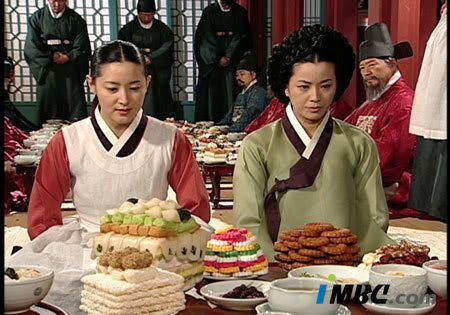
I recently finished watching a wonderful Korean television drama called Dae Jang Geum, aka Jewel in the Palace. It is available on DVD, in the original Korean with English subtitles. In briefest summary, the drama tells the story of Jang Geum, an orphaned girl who rises from the lowest classes of Korean society to become the personal physician of the King.
The struggles Jang Geum faces along the way are enough to crush the spirit of a normal man or woman. But Jang Geum is an extraordinary woman. No opponent can overcome her indomitable spirit, no obstacle or setback can impede her progress for long. She sets her sights on the goals she wants to achieve, and she moves toward them with determination, intelligence, and passion, without ever compromising her integrity or honor. She is a true Heroine of Romantic art.
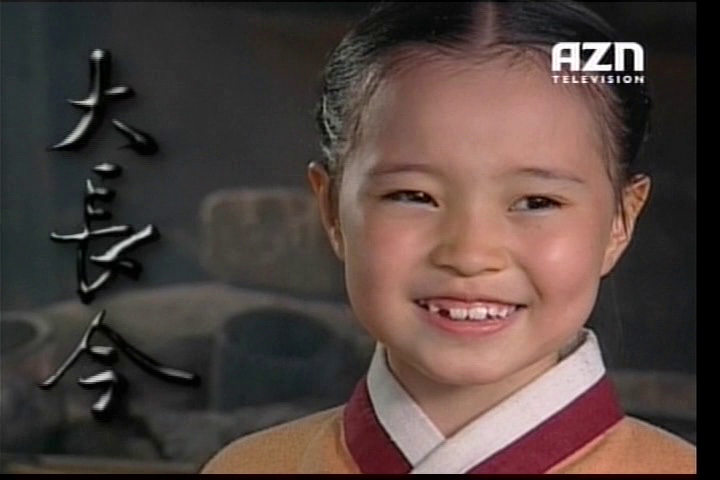
The series starts out with several episodes showing Jang Geum as a young girl, around 8 years old. From her first appearance on the screen, she conquers the viewer’s heart completely. Never have I seen such an adorable little girl. Her smile outshines the sun. But then she wins the viewer’s mind as well, when she displays her passionate intellectual curiosity, her stubborn determination, her courage and integrity.
With episode six, the story moves ahead in time. Jang Geum is a young woman of 20 or so. Under the tutelage of Lady Han, Jang Geum has become one of the most promising kitchen ladies of the palace. Her only rival is Keum Young, whose family has produced the last five Head Kitchen Ladies of the palace. One of Jang Geum’s goals is to become the Head Kitchen Lady. But Keum Young’s aunt, Lady Choi, will stop at nothing to keep that office in her family’s possession.
And so Jang Geum and Lady Han are subjected to repeated attempts by the Choi clan to discredit and defeat them, by fair means or foul. Neither Lady Han nor Jang Geum ever stoop to their level, regardless of consequence. Several times their lives hang in the balance. But they will achieve their goals with honor, or not at all.
One of the things which sets Jang Geum apart from all others is her intellectual curiosity. While others are content to follow whatever was done in the past, as passed down in books or by word of mouth, Jang Geum insists on determining for herself what is best through experimentation and logical thought, even if this goes against what others are doing, or have done in the past, or against the book authorities. Both in her cooking, and later in her medical practice, she uses the scientific method of testing ideas with experiments, and of gathering evidence out in the field, whether that meant studying all the herbs in the vicinity, or testing the water, or examining patients and their symptoms and observing their reactions to various medical prescriptions.
Another strand of the story involves a Royal Guard of the scholar-official class, Min Jeong Ho, who falls in love with Jang Geum. Like Jang Geum and Lady Han, Min Jeong Ho is a man of honor and integrity. His love for Jang Geum is a virtually hopeless romance, because court ladies such as Jang Geum are forbidden romantic relationships with anyone other than the King. If the King never shows any interest in them, then they will have to live their entire life without the love of a man. Jang Geum, however, does fall in love with Min Jeong Ho, and their struggle to resolve this dilemma is one of the major value conflicts of the story.
Complicating their relationship further, Jang Geum’s rival, Keum Young, is also in love with Min Jeong Ho. It is no light infatuation, but a love which will change the entire course of Keum Young’s life in ways that are heartbreaking to see unfold.
When Jang Geum transforms herself into a physician, she begins to have regular contact with the King. To the King’s credit, he too falls in love with Jang Geum. But to make Jang Geum his concubine - the King already has a Queen - would ruin her happiness, and the King discovers this. This is another of the dramatic value conflicts that must somehow be resolved.
Dae Jang Geum is so full of dramatic value conflicts I can’t begin to touch on them all. The contrast between Jang Geum’s way of resolving her conflicts, and the way others do, highlights her larger than life, heroic spirit and integrity. Some of the characters run away from conflicts; some are not strong enough and give in, and are weighed down with guilt; some resort to dishonorable methods to get their way; only Jang Geum and Min Jeong Ho never compromise their principles.
The antagonists of the story, especially Lady Choi and Keum Young, serve an important purpose by providing a contrast to Jang Geum’s heroism. Keum Young began as a highly skilled and precocious young lady, generous to her only rival in the kitchen, Jang Geum. But when her supreme value proved to be out of her reach, her spirit was broken, and she sadly became vindictive and dishonorable. Her aunt, Lady Choi, also started out as an innocent child with benevolent goals and dreams. Both of them could remember the time in their youth when so much had been possible. Their downfall is the all-too-common human tragedy of a great potential, given up on, never fulfilled.
Like the heroes of Victor Hugo’s Romantic novels, the heroes of Dae Jang Geum remain loyal to their values to the end, no matter the struggles they must endure to achieve them. In contemplating the lives of Jang Geum and Min Jeong Ho, of Lady Han and Lady Jung, we see life being lived as it could be, and ought to be. Their values may not be the same as ours, just as the values of Lantenac and Cimourdain (two of the central characters of Hugo's novel, Ninety-three) are not ours. But, as Ayn Rand wrote, referring to those characters: “What greatness men are capable of, when they fight for their values!”
It is such a sad, stark contrast to the flippancy, the vulgarity, the cynicism, the mock-heroism of contemporary American drama, whether on television or in movies. Seeing heroic characters who take their lives, their loves, their goals seriously, who do not laugh at themselves, is an inspiration not to be missed. I urge you to take a chance on this foreign production, an unexpected gift from a talented Korean writer to the world.
There is a website, aznVtv - The Best in Asian TV, at which you can watch every episode of Dae Jang Geum. You may need to download the Winamp player, which is free on the website. Here is the url: http://aznv.tv/en/
For a brief sample of the show, you can view many clips on YouTube.
Sunday, March 2, 2008
The "Disproportionate Use of Force"
Belatedly, Israel decided to respond more forcibly, with an incursion into Gaza by its ground forces. This is still inadequate. They have evidently only gone two or three miles inside Gaza, while the rocket launchers can operate from at least 15 miles deep in Gaza.
Nevertheless, even this inadequate response has drawn howls of outrage from the Palestinians, and the United Nations, as usual, weighed in on the side of the Palestinians, accusing Israel of responding with a "disproportionate use of force."
There is no such thing as a "disproportionate use of force" in defense against an aggressor. As the United States properly used all weapons at its disposal - including nuclear weapons - against the Japanese in WWII, so Israel can and should use all the force at its disposal to crush the Palestinian aggression until they cease to be aggressors.
How convenient the world would be for aggressors if their victims adhered to this insane doctrine of "proportionate use of force" in response to being attacked. Imagine hordes of Chinese attacking Taiwan in a maritime invasion, using only spears and rocks against the island's defenders. Adhering to the "proportionate use of force" doctrine, the Taiwanese use only spears and rocks in response. What happens? The Chinese easily defeat the moronic defenders, because there are more Chinese than Taiwanese. In short, the Taiwanese defeated themselves.
This is exactly what the Palestinians, and all the other countries in the Middle East that are hostile to Israel, want Israel to do. It is a recipe for national suicide. Yet the UN supports it, and so do many individual countries, including the United States.
No wonder aggressors are so emboldened in this era of moral grayness and moral "neutrality."
Thursday, February 28, 2008
Coddling Dictators
In any compromise between food and poison, it is only death that can win. In any compromise between good and evil, it is only evil that can profit. In that transfusion of blood which drains the good to feed the evil, the compromiser is the transmitting rubber tube . . .
Saturday, February 23, 2008
A Republic - If You Can Keep It

Thursday, February 21, 2008
Philosophy: Who Needs It

Everyone needs philosophy, was Ayn Rand's answer to that question, which she gave in an address to the graduating class at West Point in 1974. Everyone lives according to some philosophy, whether they realize it or not.
As Ayn Rand said in her address:
. . . the principles you accept (consciously or subconsciously) may clash with or contradict one another; they, too, have to be integrated. What integrates them? Philosophy. A philosophic system is an integrated view of existence. As a human being, you have no choice about the fact that you need a philosophy. Your only choice is whether you define your philosophy by a conscious, rational, disciplined process of thought and scrupulously logical deliberation - or let your subconscious accumulate a junk heap of unwarranted conclusions, false generalizations, undefined contradictions, undigested slogans, unidentified wishes, doubts and fears, thrown together by chance, but integrated by your subconscious into a kind of mongrel philosophy and fused into a single, solid weight: self-doubt, like a ball and chain in the place where your mind's wings should have grown.
So if you want to know yourself better, if you want to gain conscious control of your life, your decisions, your judgments, if you want to understand what causes your emotions, you must learn to engage in introspection.
Do you, for example, hate profit-chasing Big Oil executives? Your answer to that question, whether negative or affirmative, reveals a part of your implicit philosophy. If you dislike the desire for profit, ask yourself why. Perhaps you believe profits are immoral. Dig down another step: why do you hold that profits are immoral? Some will answer: because the desire for profit is selfish. For these people, this answer reveals that altruism is their moral philosophy, their ethics. Altruism is the moral code which holds that service to others -selflessness - is the good, and selfishness is the evil. Think Mother Teresa, the most well known altruist in recent times.
Anything opposed to altruism, such as the pursuit of profit, is immoral to an altruist. Dig further into your philosophy and ask yourself why altruism is your moral philosophy. In pursuing these elusive answers, you will be getting at your philosophical premises.
The purpose of this exercise in self-examination is to become aware of the philosophical premises that have been guiding your life subconsciously - without your authorization, so to speak. Most people will find some of the premises they have adopted, somewhere along the way, are not supportable upon close examination. Then discard them, and replace them with premises you can support.
After a lifetime of persistent self-examination, and of pestering others to do the same, the Greek philosopher, Socrates, was convicted of corrupting the minds of the young. He faced the death penalty, but it was suggested he might be allowed to live if he would accept exile, and cease to be the annoying philosophical gadfly he admitted to being. He refused the offer. The unexamined life, he said, is not worth living.
Sunday, February 17, 2008
Ragtime: A Musical Interlude
http://www.youtube.com/watch?v=pGyQmKmIMp4
I generally prefer solo piano ragtime, but this is an excellent banjo version of Dill Pickles Rag, by Charles Johnson.
Poetic Interlude
Helen, thy beauty is to me
Like those Nicean barks of yore,
That gently, o'er a perfumed sea,
The weary, wayworn wanderer bore
To his own native shore.
On desperate seas long wont to roam,
Thy hyacinth hair, thy classic face,
Thy Naiad airs have brought me home
To the glory that was Greece
And the grandeur that was Rome.
Lo! in yon brilliant window-niche
How statue-like I see thee stand,
The agate lamp within thy hand!
Ah, Psyche, from the regions which
Are Holy Land!
Edgar Allan Poe
Wednesday, February 13, 2008
Ecce Homo

Howard Roark, intransigent architect hero of Ayn Rand's novel, The Fountainhead, is one of the most inspiring creations in the history of literature. He had his own ideas about what and how to build, and he turned them into reality in spite of all the obstacles a timid and envious society could hurl against him.
Much more inspiring, though, is an intransigent hero who actually existed. Behold the man, Wilbur Wright. The oldest dream of man was to fly. Icarus, Bellerophon on Pegasus, flying carpets, and countless other myths and fables show the dream realized in fiction. Leonardo Da Vinci, a hero of the Renaissance, worked on making the dream a reality, but it was too early. Technology was not yet advanced enough.
When the technology was ready, Wilbur Wright (and to a lesser extent, Orville Wright) stepped forward and engineered the marvel of powered flight. From the dauntless self-confidence needed to believe he could achieve this "impossible dream," through long hours of research, countless brilliant experiments, successes and setbacks - all funded from the Wrights' own savings - to the epoch making first flight at Kill Devil Hills (near Kitty Hawk), Wilbur Wright overcame every obstacle.
He conquered the sky.
Wilbur Wright is man, the hero. Next time someone moans that he is "only human," remind him of what heroes men can be, by pointing to Wilbur Wright.
Monday, February 11, 2008
Once Upon a Time in America

With a population of some three million, colonial America produced more Statesmen than modern America can produce with her 300 million. How can that be, when we have the advantage of public education?
America still produces brilliant and ambitious men. But none of them yearn to be part of our Government, as they did in our Revolutionary days. Those were days of ferment when great things were being accomplished in government, namely the enshrinement of man's inalienable rights in the Declaration of Independence, the Constitution, and the Bill of Rights, and the establishment of a Republic - a nation of laws, and not of men.
What is government doing today? The long train of abuses and usurpations one could list would put those of King George III to shame. Nobody with any honor or self-respect would agree to be part of such a government, except with the express purpose of annihilating the work of the last century of misgovernment.
There are no such Statesmen today, anywhere upon the landscape.
Sunday, February 10, 2008
To Whom It May Concern

" . . . blossom of snow
may you bloom and grow,
bloom and grow forever.
Edelweiss, edelweiss,
bless my homeland forever."
From Rodgers & Hammerstein's The Sound of Music.