Tuesday, April 6, 2010
Light Bulb Moment
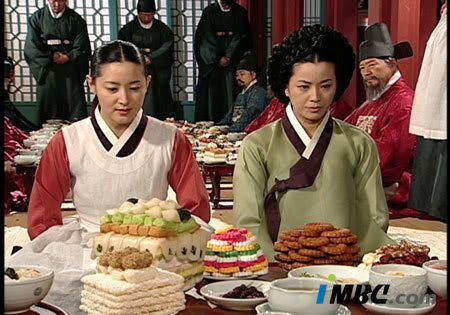
Earlier in the day, Jang Geum had run into her foster parents, and they had offered her a special type of wine in thanks for something she had done for them. They said the wine had a very good taste because it fermented well. A seemingly small plot point, but it served more than one purpose---the writer of this drama is very clever in her plotting ability.
So, Jang Geum and Lady Han go to a place where the common people make bean paste, and try to figure out why theirs still tastes good, while the paste in the palace is bad. They are told that it tastes well when it is stored in three specific locations in the village, and nowhere else. The villagers attributed this to the village gods, who were worshipped in one of these locations. As they stand at one of these places, Jang Geum looks about, and then flashes back to her foster mother's earlier comment about the wine tasting good because it fermented well. Then she had the "light bulb moment," or Eureka moment, when she realized the solution to their problem.
It turned out the bean paste was stored, in big ceramic jars, underneath chestnut and pine trees, from which pollen fell into the jars and aided the fermentation process. This had also been the case in the palace, until some of these trees were cut down. That changed the taste. Jang Geum looked at all the facts, and came up with the solution.
This is the hero of the story, admired and valued by all fellow people of good will in the drama, precisely because of her intelligence, independence, self-confidence, and benevolence. She is intrepid, and a risk taker. Just another Romantic episode in the drama of Jang Geum.
In the same episode, one of the evil characters, the Head Lady, was speaking of the Highest Kitchen Lady, Lady Jung, who is one of the good characters. The Head Lady hated Lady Jung, but admitted that she was a woman of upright character---and this was her weakness! Because, said the Head Lady, such people never make allowance for the deviousness of other people, assuming everyone is as upright as themselves. I forget what Ayn Rand called that attitude, where the evil take advantage of the good, by counting on their goodness. Anyway, it is yet another example of this writer's brilliance, and her psychological understanding of the good, and the evil.
Monday, April 5, 2010
What Is Art?
Greek Poets had their own notion of the kind of truth which their art demanded. In the fourth century Aristotle faced the issue candidly and squarely and, in discussing the difference between history and poetry, came to a clear conclusion: 'It really lies in this: the one describes what has happened, the other what might. Hence poetry is something more philosophic and more serious than history; for poetry speaks of what is universal, history of what is particular.' No Greek poets would have used precisely this language, and most of them would have been surprised to hear their work called philosophical, but they would certainly have thought it serious. But Aristotle is right to call it philosophical, because in its own way it is concerned with the revelation of truth. The truth in question, as he saw, is not of particular facts, but of universal principles or tendencies or characteristics. Even if, as is perfectly possible, there was once a historical Achilles, the importance of Homer's presentation of him is irrelevant to his existence. The Achilles whom we know is indeed universal in the sense that he embodies in a convincing and satisfying form qualities which are to be found in many men, but seldom so clearly or so forcibly as in him. To find this universal element the poet must make a severe selection from reality and present it with decisive discrimination. Just as sculptors emphasized what they thought to be the essential characteristics of their subjects at the expense of the incidental and the accidental, so poets emphasized what they thought to be the essential characteristics of human beings and showed how these led to certain kinds of result in action and suffering. They saw too that behind the infinite variety of human behaviour and fortune there must be forces at work which could to some degree be understood and presented in a concrete form. Their idea of truth was to find out these principles and forces, which were indeed at work in individuals but could best be grasped if they were abstracted from the particular case and displayed through situations which manifested more clearly their significance and their reality. (p. 134-135, emphasis added)
If you take away the Greeks' unfortunate belief in the Gods influencing man's behavior and fate, this is very similar to Objectivist aesthetics. And, as is well known, Ayn Rand subscribed to Aristotle's view that art portrays man as he "might be."
Art is a selective re-creation of reality according to an artist's metaphysical value-judgments. (The Ayn Rand Lexicon, p. 37)
By a selective re-creation, art isolates and integrates those aspects of reality which represent man's fundamental view of himself and of existence. Out of the countless number of concretes---of single, disorganized and (seemingly) contradictory attributes, actions and entities---an artist isolates the things which he regards as metaphysically essential and integrates them into a single new concrete that represents an embodied abstraction.
For instance, consider two statues of man: one as a Greek god, the other as a deformed medieval monstrosity. Both are metaphysical estimates of man; both are projections of the artist's view of man's nature; both are concretized representations of the philosophy of their respective cultures. (The Ayn Rand Lexicon, p. 37)
The Romanticists did not present a hero as a statistical average, but as an abstraction of man's best and highest potentiality, applicable to and achievable by all men, in various degrees, according to their individual choices. (The Ayn Rand Lexicon, p. 425)
Ayn Rand's aesthetic theory is more fully developed than these brief statements, of course. I am simply pointing to a possible source of inspiration, not only the Greeks and Aristotle, but C. M. Bowra's description of Greek art.
Postscript: With appropriate modifications, Bowra's description of Homer's Achilles fits a modern Romantic heroine of mine:
Even if, as is perfectly possible, there was once a historical Dae Jang Geum, the importance of Kim Yeong-hyeon's presentation of her is irrelevant to her existence. The Dae Jang Geum whom we know is indeed universal in the sense that she embodies in a convincing and satisfying form qualities which are to be found in many men, but seldom so clearly or so forcibly as in her.
Saturday, January 24, 2009
The Romantic Screen: Dae Jang Geum (2003)
“I’ll tell you this: no one can ever persuade me to give up. I’ll never give up!”Dae Jang Geum, also known as Jewel in the Palace, is a Korean television drama of 54 one hour episodes that originally aired in 2003 and 2004. It tells the story of Jang Geum, a young orphan girl, who is an outcast even among the lower classes of Korean society, and her remarkable rise to become the personal physician of the King. It is a work of Romantic art of the top rank, well worth the attention of anyone who values Romantic art.
The screenplay was written by Kim Yeong-hyeon, and it was directed by Lee Byoung-hoon. The main characters are: the child Jang Geum, who becomes the adult Jang Geum after episode 5; Keum Young, Jang Geum’s greatest rival in the palace; Lady Han, Jang Geum’s mentor in the palace, and her mother in all but name; Sir Min Jeong-ho, Jang Geum’s love interest and versatile defender of the realm; Lady Choi, Keum Young’s aunt and enemy of Jang Geum; and Lady Jung, the Highest Kitchen Lady, who is not the puppet the Choi clan had hoped she would be.
Korean television dramas are not like American drama series, in which one episode generally has little connection with the one that came before, or the one that comes after, and which only end when the ratings get too low. Korean dramas are a single story, with a beginning, middle, and end, and every episode builds upon the one before. The producers of the drama know ahead of time how many episodes the story will be, and there it ends. The closest comparison on American television would be a mini-series, such as Roots. But Korean dramas are much longer and more in depth. They are what a novel would be like, if it were fully dramatized on film.
When I say Dae Jang Geum is Romanticism of the top rank, I am referring to Ayn Rand’s standard for that ranking:
“The distinguishing characteristic of this top rank . . . is their full commitment to the premise of volition in both of its fundamental areas: in regard to consciousness and to existence, in regard to man’s character and to his actions in the physical world. Maintaining a perfect integration of these two aspects, unmatched in the brilliant ingenuity of their plot structures, these writers are enormously concerned with man’s soul (i.e., his consciousness). They are moralists in the most profound sense of the word; their concern is not merely with values, but specifically with moral values and with the power of moral values in shaping human character. Their characters are ‘larger than life,’ i.e., they are abstract projections in terms of essentials . . . In their stories, one will never find action for action’s sake, unrelated to moral values. The events of their plots are shaped, determined and motivated by the characters’ values (or treason to values), by their struggle in pursuit of spiritual goals and by profound value-conflicts. Their themes are fundamental, universal, timeless issues of man’s existence---and they are the only consistent creators of the rarest attribute of literature: the perfect integration of theme and plot, which they achieve with superlative virtuosity.” [“What Is Romanticism?” p. 91-92, The Romantic Manifesto, Ayn Rand]
Dae Jang Geum meets all of these criteria, and is therefore in a class with the works of Hugo, Rostand, and Dostoyevsky, and above the lesser Romanticists. There is not a trace of bootleg romanticism in the story, no cynicism, no mock-heroism, no apologizing for portraying heroic characters. The protagonists take themselves, their goals and ideas, seriously, and never laugh at themselves.
To begin, the title of the story is Dae Jang Geum, which means “The Great Jang Geum.” Clearly, it is not a story about the folks next door, but about a hero of Korean history. Little is known of the actual historical person, Jang Geum, which makes it easy for the author, Kim Yeong-hyeon, to make her into a heroine of her own devising. Jang Geum and the other major characters that are her allies all live life as it could be, and ought to be lived, in the context of sixteenth century Korea. When faced with moral dilemmas, each of them looks to their own hierarchy of values to determine what to do, then takes the proper action, regardless of risk.
Dae Jang Geum has been described as the story of Jang Geum’s persistence and curiosity. While she certainly exhibits both of those traits, a more accurate description of the theme of Dae Jang Geum is the same as Victor Hugo’s Ninety-Three: man’s loyalty to values. Just as in Ninety-Three, this theme is dramatized in the subplots as well as the main plot, in the minor characters as well as the major characters.
One of Jang Geum’s values is using the scientific method to discover new knowledge, and she does this over and over again in the story. When this comes into conflict with the authorities, such as when she is trying to heal a member of the royal family, she insists on following her own methods, in spite of all threats or ridicule about not following the “accepted methods.” She has an independent mind.
When her mentor, Lady Han, is put under house arrest for serving plain, healthy food to a Chinese epicure whose preference for more lavish fare is notorious, Jang Geum takes her place – and serves exactly the same plain, healthy food, at tremendous risk to herself. They both are determined to serve the envoy healthy food because he has diabetes, and needs the healthy food. Their principle is that one should only serve food that is appropriate to the one who will consume it, and they stick to that principle no matter who wants it done differently.
In another typical example, one of the minor characters, a seamstress, displays the same loyalty to values. She is assigned the task of making a new dress for Jang Geum, who is in the final cooking competition to become a court lady of the kitchen, or be sent out of the palace if she fails. Out of the blue, the seamstress steals the flour from the ingredients set aside for Jang Geum’s use in her competition, which cannot be replaced.
Jang Geum is dumbfounded by this seemingly inexplicable act. But we soon learn the reason for it. The seamstress intends to use the flour to make dumplings as part of a beau geste toward her mother, who she has just learned is leaving the palace the next day, never to return. She wants to serve a ceremonial dinner to her mother before she leaves to show her love. She only has this one chance to do so. This act is of such value to her that she is willing to ruin Jang Geum’s chances of becoming a court lady, and accept any consequence to herself, to carry it out. The seamstress is a very timid girl, but when her highest values are at stake, she becomes uncommonly bold and extraordinarily courageous. The author does a marvelous job of showing how the seemingly improper things the seamstress does are actually the proper things for her to do, given her hierarchy of values. And Jang Geum, once she understands the girl’s motivation for her act, actually helps the girl make the dumplings and present them to her mother.
A Romantic story, above all, requires a plot: “a purposeful progression of logically connected events leading to the resolution of a climax,” (“What Is Romanticism? p. 82, The Romantic Manifesto, Ayn Rand). Such a series of events, in a Romantic work, must be set in motion by the protagonist choosing a goal (final causation), and then taking the steps required to achieve it (efficient causation). Jang Geum does exactly that.

Early in the story, Jang Geum is an adorable, radiant young girl – Shirley Temple on the outside, an incipient Madame Curie on the inside. She sneaks off to school with her “betters” against her mother’s explicit orders. She is simply too eager to learn, for anything to hold her back. Then her parents’ past catches up with them, and Jang Geum is left alone to face the world as an eight year old orphan. She makes the conscious decision to vindicate her mother’s honor, which has been wrongly maligned. This is the goal toward which she directs herself. Then she methodically takes all the steps necessary to achieve it. It is a purposeful progression of logically connected events, which leads to the resolution of a climax.
Similarly, the subplots have various characters working purposefully toward their own goals. Lady Jung, for example, initially wanted to be a court lady because it seemed like a beautiful and glamorous life from outside the palace. Once inside, however, she realized that many people used their positions as court ladies of the kitchen to advance their political causes and to gain power. For example, some of them would poison the food of certain royals to help other royals gain power, thereby gaining a powerful ally. Lady Jung believed it was wrong to use food for such purposes, so she dedicated herself to eradicating the practice. Then she took the steps necessary to achieve that purpose.
Finally, as if to emphasize the purposeful nature of Jang Geum and her story, one of the episodes specifically dramatizes the value of purpose in man’s life. In the episode, Jang Geum has been exiled to the herb garden, in the farthest corner of the palace complex, for some alleged transgression. It is a place to which loafers, miscreants, drunks and criminals are sent, and no one expects to return to the palace proper from the herb garden. It is essentially a place of exile and abandonment.
At the herb garden, the workers are supposed to be growing herbs. But none of them do any gardening, or in fact any kind of work, at all. When Jang Geum arrives, she finds the workers - and even their supervisor - lying in the fields, asleep. When she asks them what she is supposed to do, the supervisor tells her not to do anything, unless she wants to drink. No one expects any work to be done in the herb garden, and all the people there are content to do nothing, wasting away their existence drinking, eating, and sleeping, without purpose. These men are clearly going to pot, their minds and bodies atrophying from lack of use. It is against this background that we are able to contrast the behavior of Jang Geum.
Jang Geum finds their behavior incomprehensible. She literally goes to bed weeping at the apparent purposelessness of life in the herb garden. Finally, she tells the supervisor she cannot "do nothing," as it would drive her crazy. So she begins collecting all the assorted herb seeds she can find in the storehouse, none of which have any identifying labels attached to them. Those she recognizes, she labels accordingly. For those she cannot identify, she bothers the supervisor until he identifies them for her. Soon she has them all identified, and she begins clearing some of the weed infested field and planting some of the herbs.
The other workers, and the supervisor, watch her and laugh at the "futility" of her actions. They begin taking bets on how soon she will give up - or worse. The last court lady sent to the herb garden had committed suicide. But Jang Geum persists in her methodical categorizing and gardening.One day she comes to the workers and asks them for better gardening techniques. One of them mentions a particular herb that no one has succeeded in growing, though they had been trying for 20 years. Immediately, Jang Geum's face brightens, and she says: "Good! I will use that!" When they ask what she means, she explains that she will use that as her goal, as a purpose toward which to strive while in the herb garden. But why that particular goal? "Because you said it was hard!"
After a methodical trial and error period, Jang Geum succeeds in growing the rare herb - and finally the other workers, and the supervisor, begin to admire Jang Geum, and to want to bring some purpose back into their own lives, as well. They all recognize, once they have seen it again, the ennobling, uplifting value of purpose.Jang Geum taught them that, though it was not her intention. She simply wanted purpose in her own life. But her good example had a salutary effect on all those around her.
And not coincidentally, Jang Geum's success in growing the rare herb brings about a longer range goal: she is allowed to return to the palace as a court lady in training, her status fully restored. Thus did the writer of Dae Jang Geum - Kim Yeong-hyeon - dramatize the value of purpose in man's life.
The author’s characterization skills are everywhere apparent. The characters are constantly shown deliberating with themselves on what course of action to take, consciously weighing the alternatives, completely in focus. When they do something immoral according to their own values, they know it, and suffer a blow to their self-esteem as a consequence.
In one scene, for example, Keum Young sets in motion an evil plot, knowing it is immoral – but doing it anyway. Then in a voiceover, she says to herself:
“So this is how I’m going to live. I’m going to console myself like this . . . “
Lady Han is a character in whom love for her friends is extremely important, as well as integrity in her profession. In her early years at the palace, she saw her best friend forced to take poison after being falsely accused of some transgression. It left her alone and friendless in the palace, until Jang Geum came along and was like a daughter to her.

(Lady Han comforting Jang Geum.)
Then a situation arises in which Lady Jung has a chance to expose some of the wrongdoers among the court ladies of the kitchen. Due to complicated circumstances, however, it would also lead to the execution of Jang Geum, despite her complete innocence. Lady Han supports Lady Jung in her efforts to drive the vipers out of the kitchen. But she simply cannot accept losing Jang Geum into the bargain. She goes to plead with Lady Jung – who also does not want to lose Jang Geum, but sees no way around it – in a scene of amazing emotional intensity. Lady Han reiterates her support for Lady Jung’s policies, but begs desperately for her to use some other occasion to carry it out. Not this time, when it will take Jang Geum away from her: “Next time! Next time!” It is perfectly in character for Lady Han to act this way, given her love for Jang Geum, and her fear of losing her best friend to an unjust death - twice.
And in a scene remarkable for its moral clarity, Jang Geum forces Keum Young to examine herself more deeply than ever before:
Jang Geum: Keum Young, please turn yourself in. Please, help me forgive you. For you, self-respect is more important than the safety of your family.
Keum Young: What do you think you know about me that you speak of me like this?
JG: No? Am I wrong then? Then why are you teaching all the ladies in the same way that Lady Han taught me? Please put into action what you feel in your heart. Keum Young, I don’t like hating you. Because hating someone is as difficult as loving someone.
KY: I had to both hate and love, which was so difficult. Because of you, because of Sir Min . . . You’re the one who has hurt my self-respect.
JG: That’s just an excuse . . .
KY: Get out.
JG: Self-respect isn’t hurt by someone else but only by oneself.
KY: Get out, get out!
If there are flaws in the story, they are few and minor. The very first episode has characters who are fatalists, and these are Jang Geum’s own parents. But this is simply a character flaw in these people, and Jang Geum herself exhibits no belief in that doctrine.
Later in the story, Keum Young explicitly rejects fatalism. Her aunt, Lady Choi, exerts enormous pressure on Keum Young to perform some criminal act as part of her “training” to continue the family’s power by hook or by crook. Lady Choi says it is their family’s fate to have to do these things. Keum Young strives mightily to refuse this act, but finally the pressure gets to her, and she agrees to do it. At the same time, however, she rebukes Lady Choi and rejects the idea of fatalism:
“I’m doing this because you say it’s our fate. But this kind of fate shall end in my generation. I’ll certainly make it so.”
And in any case, all of the main characters act on the premise of volition, from first to last.
Although Jang Geum strives to achieve her own goals, there is certainly an undercurrent of altruism throughout the story. But this is common to most Romantic literature outside of Ayn Rand. While we may not have the same values, we can say, as Ayn Rand said about Hugo:
“The emphasis he projects is not: ‘What great values men are fighting for!’ but: ‘What greatness men are capable of, when they fight for their values!’” (Introduction to Ninety-Three, p. xii).
There is not a lot of Romantic art in the modern world. Nevertheless, we all need the inspirational fuel that Romantic art provides. Dae Jang Geum is a new and magnificent addition to the world’s library of Romantic art.

Sunday, October 12, 2008
Dae Jang Geum on the Value of Purpose

Episode Seven of Dae Jang Geum addresses the value of purpose in man's life, and the awful state of men without purpose. Having decided to dramatize this issue, how to proceed?
The wonderful writer of DJG solved the problem in this way. First, Jang Geum got into trouble for going outside of the palace, which was strictly forbidden without special permission. The Head Lady decided to expel her from the palace, the standard punishment for that transgression. Everyone is appalled, knowing as they do that Jang Geum is one of the best among them, if not in fact the best. Finally, the Head Kitchen Lady, named Lady Jung, and Jang Geum's mentor, Lady Han, offer to forgo three year's worth of their salary if the Head Lady will allow Jang Geum to stay in the palace. This shows how highly the best and the brightest of the palace women value Jang Geum. The Head Lady greedily accepts their offer, but still banishes Jang Geum to the lowliest section of the palace grounds - the herb garden. It is a place to which loafers, miscreants, drunks and criminals are sent, and no one expects to return to the palace proper from the herb garden. It is essentially a place of exile and abandonment.
At the herb garden, the workers are supposed to be growing herbs. But none of them do any gardening, or in fact any kind of work, at all. When Jang Geum arrives, she finds the workers - and even their supervisor - lying in the fields, asleep. When she asks them what she is supposed to do, the supervisor tells her not to do anything, unless she wants to drink. No one expects any work to be done in the herb garden, and all the people there are content to do nothing, wasting away their existence drinking, eating, and sleeping, without purpose. These men are clearly going to pot, their minds and bodies atrophying from lack of use. It is against this background that we are able to contrast the behavior of Jang Geum.
Jang Geum finds their behavior incomprehensible. She literally goes to bed weeping at the apparent purposelessness of life in the herb garden. Finally, she tells the supervisor she cannot "do nothing," as it would drive her crazy. So she begins collecting all the assorted herb seeds she can find in the storehouse, none of which have any identifying lables attached to them. Those she recognizes, she labels accordingly, for those she cannot identify she bothers the supervisor until he identifies them for her. Soon she has them all identified, and she begins clearing some of the weed infested field and planting some of the herbs.
The other workers, and the supervisor, watch her and laugh at the "futility" of her actions. They begin taking bets on how soon she will give up - or worse. The last court lady sent to the herb garden had committed suicide. But Jang Geum persists in her methodical categorizing and gardening.
One day she comes to the workers and asks them for better gardening techniques. One of them mentions a particular herb that no one has succeeded in growing, though they had been trying for 20 years. Immediately, Jang Geum's face brightens, and she says: "Good! I will use that!" When they ask what she means, she explains that she will use that as her goal, as a purpose toward which to strive while in the herb garden. But why that particular goal? "Because you said it was hard!"
After a methodical trial and error period, Jang Geum succeeds in growing the rare herb - and finally the other workers, and the supervisor, begin to admire Jang Geum, and to want to bring some purpose back into their own lives, as well. They all recognize, once they have seen it again, the ennobling, uplifting value of purpose.
Jang Geum taught them that, though it was not her intention. She simply wanted purpose in her own life. But her good example had a salutary effect on all those around her.

And not coincidentally, Jang Geum's success in growing the rare herb brings about the thing she most desires at the moment: she is allowed to return to the palace as a court lady in training, her status fully restored.
Thus did the writer of Dae Jang Geum - Kim Yeong-hyeon - dramatize the value of purpose in man's life. This is but one wonderful episode in a magnificent, 54 episode series called Dae Jang Geum.
I paid more than $200 for the full three volumes of this series and it was worth every penny - and would still have been worth it at ten times the cost. It's that good.
Saturday, August 30, 2008
A Word and Its Meaning
I recently purchased the booklet called Glossary of Objectivist Definitions, which includes definitions by Ayn Rand, Leonard Peikoff, and Harry Binswanger. Having a solid grasp of the meaning of the words one uses is obviously important. I thought it would be a good exercise to occasionally take one of the definitions, and then give an example of it in action, either in the real world or the world of art.
Here is the Glossary's definiton of integrity:
"Integrity" is loyalty in action to one's convictions and
values. (Glossary of Objectivist Definitions, p. 25.)
As given, this definition is open to misinterpretation. It leaves open the question of whether one's convictions and values are rational. Being loyal in action to irrational values is not an example of integrity. And as I suspected, when I turned to the original passage from which this definition was taken, the chapter on Virtues in Leonard Peikoff's Objectivism: the Philosophy of Ayn Rand, he does indeed qualify integrity to mean loyalty to rational values:
Like independence, integrity is a derivative of rationality and precludes any form of emotionalism. It does not mean loyalty to arbitrary notions, however strongly one feels they are true. Adolf Hitler acting faithfully to carry out his hatred of the Jews is not an example of virtue. Integrity means loyalty not to a whim or delusion, but to one's knowledge, to the conclusions one can prove logically. Like every other virtue, therefore, integrity presupposes a mind that seeks knowledge, a mind that accepts and follows reason. (Leonard Peikoff, OPAR, p. 261, paperback edition.)There are countless good examples of integrity in the Korean drama, Dae Jang Geum. Integrity is one of Jang Geum's distinguishing characteristics, which separates her from most other people of that time, or any other.
A good example that comes immediately to mind is an episode in which a high ranking Chinese envoy comes to visit the Korean King, and Lady Han and Jang Geum are chosen to cook for him. At first, they begin preparing the tastiest dishes a healthy man could wish for. The Head Eunuch had told them that: "We can't allow even a hint of fault in formalities or food. The senior envoy is a well known epicure in China. If it's not the best of delicacies, he won't even touch it. So show your best talent."
But then they learn that the Chinese envoy has diabetes, and is in poor health after his long journey. So Lady Han instead prepares the healthy foods, mostly vegetables, that are best for a diabetic, without telling the Head Eunuch.
When this food is served to the envoy, the Korean dignitaries are horrified, and so is the Chinese envoy. Lady Han tries to explain. Both she and Jang Geum believe that a cook's purpose is to prepare food that is both palatable, and proper for the person who will be consuming it. A diabetic must be served healthy food, even if he is too shortsighted to choose to eat it himself. "I dare to say the greasy food of Ming is very detrimental to his health."
The result of this conflict is that Lady Han is arrested and put in confinement until a decision is made on her ultimate punishment. In the meantime, Jang Geum steps in for Lady Han. Here she could, as most people would do, simply substitute some tastier, less healthy food for the Chinese envoy, which is exactly what he and the Korean dignitaries specifically order her to do. But she refuses. "We cannot possibly bring food that is harmful for the person."
In the face of threats of her own arrest, and very possibly being executed, Jang Geum insists on serving the same healthy food that Lady Han had planned to serve. The Chinese envoy is struck by her courage, but still does not want the healthy food. Jang Geum reasons with him, explaining that within as few as five days he will begin to feel better if he only eats the healthy food she plans to serve. Finally, the envoy agrees to eat it. But he does so with this proviso: "Will you receive any punishment I order - even if it means your life [if I am not satisfied with the food]?"
Jang Geum accepts the terms. She has confidence in her knowledge of food and its effect on a person's health, and more importantly, she refuses to go against her conviction that a cook must serve food proper to the person consuming it, in this case a diabetic.
Meanwhile, the Head Eunuch, who is generally a good person, but not as courageous as he might be, goes to Lady Han and asks her "How could you prepare such a meal?" He knows the envoy has diabetes, but is only concerned with giving him what he wants. Lady Han responds perfectly, by saying: "Then are you telling me to do the same thing to the King as well?" In other words, is he telling her that she should serve the King unhealthy food also, even if it kills him? The Head Eunuch is unable to respond to this point, because he knows Lady Han is right.
In stark contrast to the integrity of Jang Geum and Lady Han, their arch enemies, Lady Choi and Keum Young, begin preparing a feast of royal proportions for the Chinese envoy, confident that he will not be satisfied with the plain, healthy food Jang Geum will be serving. The meals Lady Choi prepares are the very greasy Ming dishes that are worst for a person with diabetes, but they are exactly the kind of foods that the Chinese envoy enjoys eating.
After the five days of eating Jang Geum's healthy food are up, Lady Choi immediately serves the envoy her lavish meal of tasty - but unhealthy - dishes. The envoy samples several of the dishes and is obviously delighted with their taste. Lady Choi smiles, anticipating a decisive victory over Lady Han and Jang Geum. But then the envoy stops eating her food, and says that although it is very tasty, he now realizes the healthy food is the better choice. He does indeed feel better after five days of Jang Geum's healthy food, which she managed to make tasty enough to satisfy the finicky envoy.
So Lady Han is realeased from confinement, Jang Geum is praised for doing the right thing (by all the same people who would have condemned her, if she had not satisfied the envoy), and Lady Choi is mortified by her loss of face. The actions of Lady Han and Jang Geum are a perfect example of loyalty in action to one's convictions and values, a perfect example of integrity.
And that example could be multiplied by anyone who watches Dae Jang Geum, for Jang Geum, along with Lady Han, Lady Jung, and Min Jeong Ho, are all heroic characters distinguished for their integrity throughout their entire lives.
[Edited 09-01-2008]
Sunday, August 3, 2008
Escapism aka Fantasy
Some remnants of Romanticism may still be found in the popular media---but in such a mangled, disfigured form that they achieve the opposite of Romanticism's original purpose . . .
Under the pressure of conformity . . . today's Romanticists are escaping, not into the past but into the supernatural---explicitly giving up reality and this earth. The exciting, the dramatic, the unusual---their policy is declaring, in effect---do not exist; please don't take us seriously, what we're offering is only a spooky daydream. (Ayn Rand, What Is Romanticism?)
I use the above quote not to suggest that Ayn Rand would agree with my assessment of modern fantasy, but to show that she saw the perils inherent in the genre, to which some had already succumbed. My view is that virtually all modern fantasy has descended into escapism.
And I am sick to death of it. In literature, in tv shows, and in movies, fantasy is flooding the marketplace. In modern history fantasy was little more than a blip on the radar screen, until Tolkien's The Lord of the Rings was published. After that, the deluge.
First it wormed its way into the science fiction section of book stores and grew like a weed until there was little if any science fiction left that was worthy of the name. Just a lot of fantasy masquerading as science fiction.
I'm not sure what started the craze for fantasy shows on television. There were a few mild ones in the 60s, such as Bewitched and I Dream of Jeannie. Now they are everywhere. And instead of it being something to laugh at, as it was with the two aforementioned shows, we are expected to take it seriously in shows like Charmed, Buffy the Vampire Slayer, Angel, The X-Files, Lost, etc.
What makes a blockbuster movie these days? Fantasy and comic book heroes. The Lord of the Rings. The Chronicles of Narnia. The Golden Compass. Spiderman. Batman. Harry Potter. The Mummy. Hellboy. Ironman. Etc., ad nauseum.
Now the big seller among fiction books, after the fantasy Harry Potter phenomena has died down a bit, is what? A series about vampires, The Twilight Saga, by Stephenie Meyer. It's selling like hotcakes.
Why do authors want to set their stories in unreal worlds? Anti-rational worlds? Why do they want their characters to have magical powers? What is it about real life that so bores them, that they have to imagine a different world where A is not A. In order to be heroic, why must a man have unreal superpowers? Why do readers want to read this stuff, instead of stories about heroes in the real world, who have only their human mind and human body to use in dealing with the problems that beset them? Why do people want to escape the real world, and run away into fantasy?
The impression all this escape into fantasy worlds leaves is that heroism isn't possible in the real world. Heroes are only possible in some other, fantasy world. In this sad vale of tears we actually inhabit, we must simply accept that there are no heroes.
Is the real world perfect? Far from it. But heroes don't run away and hide in little fantasy worlds. They fight to make their world better with what they have: their rational mind, their physical courage, their integrity. Wherein is there any need for fantasy here? There is nothing magical about it. It's not superhuman, it is simply man, the paragon of animals, man the hero, living up to his potential.
If you want to see what real literature can and should be like, watch Dae Jang Geum. Thank goodness someone is still creating great, realist art.
[Edited 8-13-08]
Saturday, April 5, 2008
Dae Jang Geum
I recently finished watching a wonderful Korean television drama called Dae Jang Geum, aka Jewel in the Palace. It is available on DVD, in the original Korean with English subtitles. In briefest summary, the drama tells the story of Jang Geum, an orphaned girl who rises from the lowest classes of Korean society to become the personal physician of the King.
The struggles Jang Geum faces along the way are enough to crush the spirit of a normal man or woman. But Jang Geum is an extraordinary woman. No opponent can overcome her indomitable spirit, no obstacle or setback can impede her progress for long. She sets her sights on the goals she wants to achieve, and she moves toward them with determination, intelligence, and passion, without ever compromising her integrity or honor. She is a true Heroine of Romantic art.
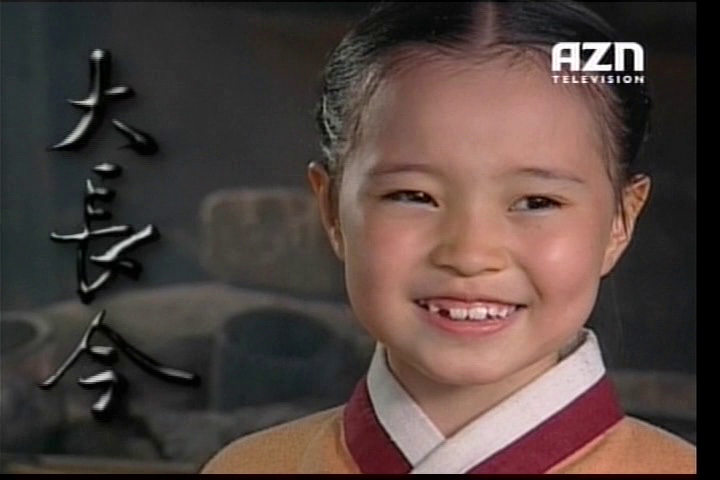
The series starts out with several episodes showing Jang Geum as a young girl, around 8 years old. From her first appearance on the screen, she conquers the viewer’s heart completely. Never have I seen such an adorable little girl. Her smile outshines the sun. But then she wins the viewer’s mind as well, when she displays her passionate intellectual curiosity, her stubborn determination, her courage and integrity.
With episode six, the story moves ahead in time. Jang Geum is a young woman of 20 or so. Under the tutelage of Lady Han, Jang Geum has become one of the most promising kitchen ladies of the palace. Her only rival is Keum Young, whose family has produced the last five Head Kitchen Ladies of the palace. One of Jang Geum’s goals is to become the Head Kitchen Lady. But Keum Young’s aunt, Lady Choi, will stop at nothing to keep that office in her family’s possession.
And so Jang Geum and Lady Han are subjected to repeated attempts by the Choi clan to discredit and defeat them, by fair means or foul. Neither Lady Han nor Jang Geum ever stoop to their level, regardless of consequence. Several times their lives hang in the balance. But they will achieve their goals with honor, or not at all.
One of the things which sets Jang Geum apart from all others is her intellectual curiosity. While others are content to follow whatever was done in the past, as passed down in books or by word of mouth, Jang Geum insists on determining for herself what is best through experimentation and logical thought, even if this goes against what others are doing, or have done in the past, or against the book authorities. Both in her cooking, and later in her medical practice, she uses the scientific method of testing ideas with experiments, and of gathering evidence out in the field, whether that meant studying all the herbs in the vicinity, or testing the water, or examining patients and their symptoms and observing their reactions to various medical prescriptions.
Another strand of the story involves a Royal Guard of the scholar-official class, Min Jeong Ho, who falls in love with Jang Geum. Like Jang Geum and Lady Han, Min Jeong Ho is a man of honor and integrity. His love for Jang Geum is a virtually hopeless romance, because court ladies such as Jang Geum are forbidden romantic relationships with anyone other than the King. If the King never shows any interest in them, then they will have to live their entire life without the love of a man. Jang Geum, however, does fall in love with Min Jeong Ho, and their struggle to resolve this dilemma is one of the major value conflicts of the story.
Complicating their relationship further, Jang Geum’s rival, Keum Young, is also in love with Min Jeong Ho. It is no light infatuation, but a love which will change the entire course of Keum Young’s life in ways that are heartbreaking to see unfold.
When Jang Geum transforms herself into a physician, she begins to have regular contact with the King. To the King’s credit, he too falls in love with Jang Geum. But to make Jang Geum his concubine - the King already has a Queen - would ruin her happiness, and the King discovers this. This is another of the dramatic value conflicts that must somehow be resolved.
Dae Jang Geum is so full of dramatic value conflicts I can’t begin to touch on them all. The contrast between Jang Geum’s way of resolving her conflicts, and the way others do, highlights her larger than life, heroic spirit and integrity. Some of the characters run away from conflicts; some are not strong enough and give in, and are weighed down with guilt; some resort to dishonorable methods to get their way; only Jang Geum and Min Jeong Ho never compromise their principles.
The antagonists of the story, especially Lady Choi and Keum Young, serve an important purpose by providing a contrast to Jang Geum’s heroism. Keum Young began as a highly skilled and precocious young lady, generous to her only rival in the kitchen, Jang Geum. But when her supreme value proved to be out of her reach, her spirit was broken, and she sadly became vindictive and dishonorable. Her aunt, Lady Choi, also started out as an innocent child with benevolent goals and dreams. Both of them could remember the time in their youth when so much had been possible. Their downfall is the all-too-common human tragedy of a great potential, given up on, never fulfilled.
Like the heroes of Victor Hugo’s Romantic novels, the heroes of Dae Jang Geum remain loyal to their values to the end, no matter the struggles they must endure to achieve them. In contemplating the lives of Jang Geum and Min Jeong Ho, of Lady Han and Lady Jung, we see life being lived as it could be, and ought to be. Their values may not be the same as ours, just as the values of Lantenac and Cimourdain (two of the central characters of Hugo's novel, Ninety-three) are not ours. But, as Ayn Rand wrote, referring to those characters: “What greatness men are capable of, when they fight for their values!”
It is such a sad, stark contrast to the flippancy, the vulgarity, the cynicism, the mock-heroism of contemporary American drama, whether on television or in movies. Seeing heroic characters who take their lives, their loves, their goals seriously, who do not laugh at themselves, is an inspiration not to be missed. I urge you to take a chance on this foreign production, an unexpected gift from a talented Korean writer to the world.
There is a website, aznVtv - The Best in Asian TV, at which you can watch every episode of Dae Jang Geum. You may need to download the Winamp player, which is free on the website. Here is the url: http://aznv.tv/en/
For a brief sample of the show, you can view many clips on YouTube.